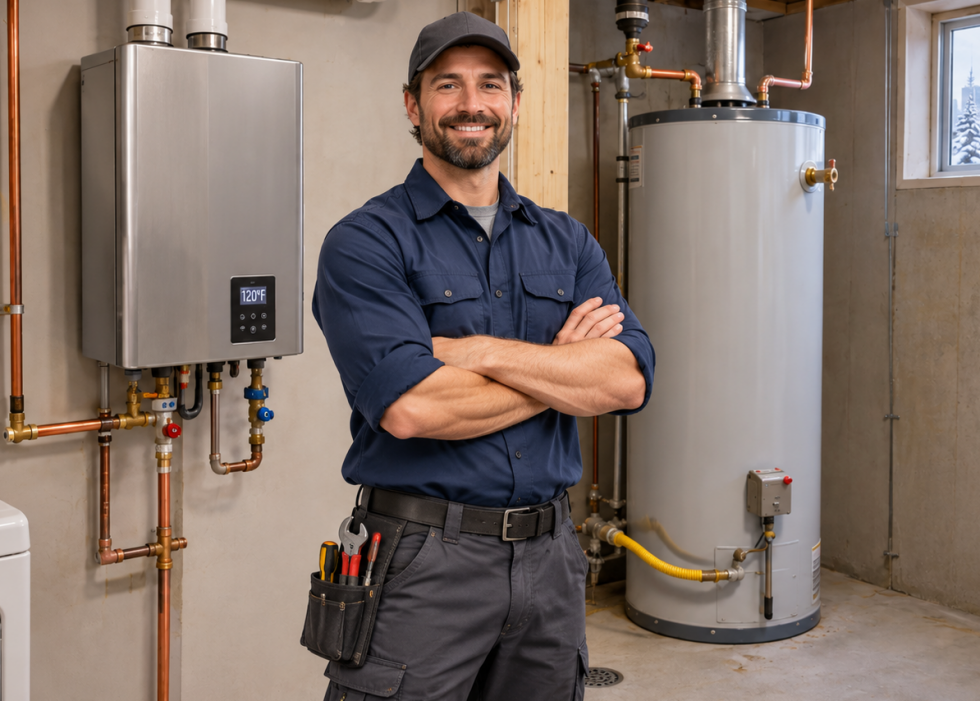
Neither one wins outright. A storage tank costs less to install, handles a few fixtures at once without complaint, and drops into most homes with little fuss. An on-demand unit costs more upfront, runs leaner, lasts roughly twice as long, and frees up floor space. Your household size, your peak hot water draw, and how long you plan to stay in the house decide which one makes sense.
You’re third in line for the shower on a Saturday morning. Halfway through the rinse, the water slides from hot to lukewarm to something closer to a cold plunge. Anyone who’s lived that moment has had the same thought on the way out of the bathroom: there has to be a better setup.
That thought usually comes down to one comparison: the
tankless vs. tank water heater
question most homeowners run into sooner or later. The more you read, the murkier it gets. One article promises endless hot showers. The next warns of a surprise bill for gas-line work. Both sound convincing, because both are partly right.
Our winters, our mineral-heavy water, and the way older basements were plumbed all shift the math in ways a generic online guide skips. What follows directly compares how these two systems perform in local homes, starting with the mechanics and cost.
Storage Tanks and On-Demand Units: How They Heat and What They Cost
The difference comes down to timing. A storage unit keeps 40 to 75 gallons hot around the clock, so it’s ready the second you turn on a tap. An on-demand unit heats nothing until water starts moving through it, then fires a burner and warms that water as it passes. Price, lifespan, winter performance, and maintenance all follow from that one design choice.
The Two Systems at a Glance
| Factor | Storage tank | On-demand (tankless) |
| Typical install cost | Lower | Two to three times higher |
| Lifespan | 8 to 12 years | 18 to 20 years with upkeep |
| Space needed | Closet-sized footprint | Wall-mounted, about suitcase size |
| Hot water supply | Limited to tank volume | Continuous, but capped by flow rate |
| Standby energy loss | Yes, reheats constantly | None |
| Annual maintenance | Flush recommended | Descaling strongly recommended |
Where the Install Budget Really Goes
Sticker price is the least useful number in a tank vs tankless water heater comparison. The storage model is cheaper to buy and usually fits where the old one did, reusing the existing venting and gas connections. The on-demand model tends to pull other work into the job:
- A larger gas line, since the burner fires much harder than a tank’s
- New stainless venting through an exterior wall
- Electrical for the unit’s controls and fan
- A permit and inspection, which Alberta requires for this kind of swap
Those add-ons are what stretch a quote. Monthly savings are real but modest, so payback runs long. That matters a lot if you might sell within a few years.
Why Winter Intake Temperature Changes the Flow Rate
Groundwater arriving at your house in January is far colder than what shows up in July. An on-demand unit has to lift that water the whole way in a single pass, so its usable flow rate drops once the ground freezes. A model that runs two showers comfortably in September can struggle to handle a shower plus a dishwasher in February.
Sizing fixes this, though it means buying a bigger and pricier unit than the headline spec suggests. A storage tank avoids the issue because it already does the heating. Cold intake just means a slower recovery between draws.
Scale Buildup and What Hard Water Does to Each
Our municipal supply contains many dissolved minerals that drop out of solution as soon as water is heated. Both systems suffer, in different ways:
- Tanks collect sediment on the bottom, which insulates the burner and shortens the unit’s life. An annual flush helps.
- On-demand units build scale inside a narrow heat exchanger, restricting flow and triggering error codes. Skipping the yearly descale is the quickest way to void a warranty.
Many households add a softener or scale filter to protect the equipment and the rest of the plumbing.
Knowing
how each system behaves
is one thing. Matching one to your actual household is another, and that comes down to a handful of practical questions.
Sizing the Decision Around Your Busiest Morning
Spec sheets describe average conditions. Your water heater has to survive your worst-case hour, so start there instead.
Five Questions to Answer Before You Shop
- How many fixtures run at once during your peak hour? Two showers plus a load of laundry is a different demand than one bathroom.
- How long will you stay in the home? A longer stay justifies the higher upfront investment.
- Is floor space tight? Freeing a basement corner has real value in a smaller house or a townhome.
- Does the home have a suite or a basement rental? Separate demand patterns usually point toward different solutions.
- What do the existing venting and gas service look like? This single factor swings an installation quote more than anything else.
Which Homes Suit Which Water Heater
| Household | Usually the better fit | Why |
| Couple, one bathroom, older bungalow | Storage | Low peak demand, simple swap, lowest cost |
| Family of five, two or three bathrooms | On-demand, properly sized | Avoids running dry during the morning rush |
| Infill or newer build with no chimney | On-demand | Already set up for sidewall venting |
| Rental property or short-term hold | Storage | Faster payback, cheaper to replace later |
| Home with a basement suite | Either, sized generously | Overlapping demand is the real constraint |
What to Ask a Contractor Before You Sign
The installation matters more than the unit’s badge. Ask anyone quoting the job for three things in writing:
- A load calculation showing the unit is sized for your peak demand
- Confirmation that the permit and inspection are included
- A maintenance schedule with the yearly cost attached
Get at least two quotes and compare what each one covers rather than the bottom line. One may have priced in a gas line upgrade while the other quietly left it out.
Strip away the marketing and the tankless vs tank water heater Calgary debate comes down to your budget horizon and your peak hour demand, not efficiency ratings. Both are proven systems once they’re sized correctly and maintained.
Picking the System Your Home Can Actually Support
There’s no universally correct answer here, and any guide that declares one is selling something. A storage tank remains a sensible, affordable choice for many homes, especially smaller households, properties you may sell soon, and homes where the existing venting makes a swap straightforward. An on-demand system rewards larger families, long-term owners, and anyone who wants that basement corner back.
Sizing and upkeep tie them together. A tankless water heater Calgary homes can count on is built for a January morning rather than a July afternoon, and it gets descaled every year without fail. A tank earns its full lifespan the same way, through an annual flush.
Before you shop, calculate your peak-hour demand and check what your gas and venting setup can support. Get those two answers first and the equipment choice mostly makes itself.