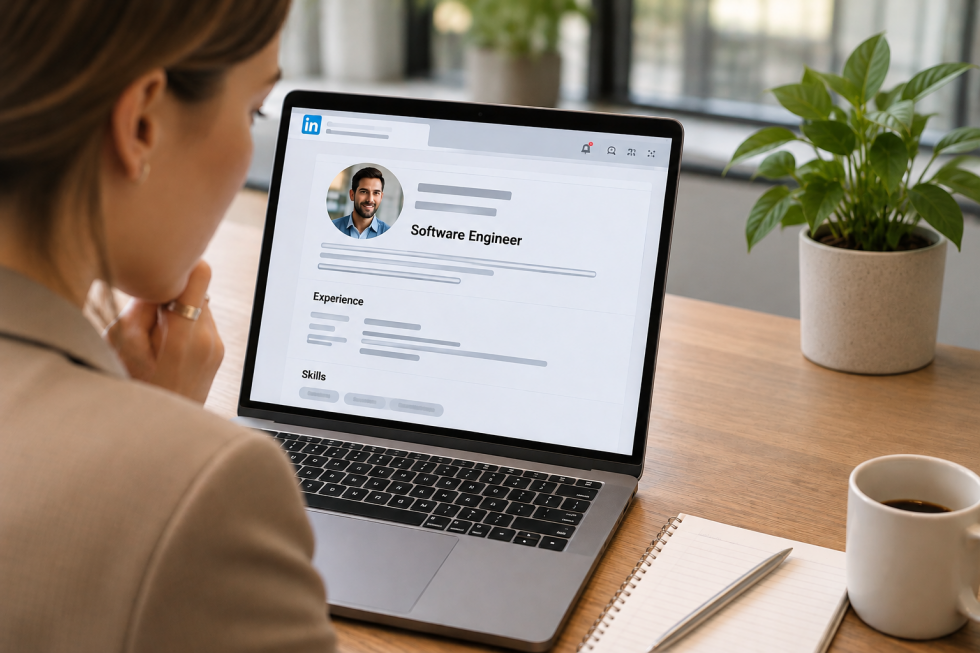
Could a recruiter overlook years of relevant experience because your online profile fails to communicate your value? An experiment published in Frontiers in Psychology tested how 480 hiring decision-makers respond to candidates’ online content. The findings showed that negative social media content can overshadow professional competence, even for highly qualified candidates.
This matters because recruiters often assess candidates before they meet them in person. They look for evidence that your experience matches the role, your skills meet its requirements, and your professional background makes sense. They also notice how clearly you communicate your expertise and whether your public information supports your application.
Understanding these early signals helps you present your experience more effectively. Instead of trying to impress everyone, make it easy for the right recruiter to recognize your fit, verify your skills, and decide to learn more.
The First Scan Is About Fit, Not Flair
Recruiters look for a quick connection between the vacancy and your professional story. They scan your headline, current role, recent experience, location, core skills and career growth. “Marketing Manager | SEO and Growth Strategy” communicates far more than “Open to Opportunities”. Use your summary to explain the work you do, the problems you solve and the value you bring.
Keep job titles, dates and qualifications aligned across your CV, LinkedIn profile and portfolio. Explain career breaks or overlapping freelance projects instead of leaving recruiters to guess. Even strong experience loses force when basic details contradict one another.
Once a recruiter sees a possible fit, they need a reliable way to contact you. An informal address like cooldude1998@gmail.com may feel personal.
However, a portfolio website showcasing your projects, with a dedicated professional email account, creates a consistent professional identity. It is also convenient for recruiters to connect your message with your work, help you manage recruiter conversations on one platform, and protect sensitive correspondence.

Evidence Makes Skills Believable
A list of strengths tells recruiters what you claim you can do. LinkedIn’s Future of Recruiting report found that 93% of talent acquisition professionals consider accurate skills assessment crucial to improving quality of hire. Recruiters therefore look for proof such as projects, measurable outcomes, certifications, tools, and the scope of your responsibilities.
Replace vague claims with specific evidence:
- Project Managers / Coordinators: Instead of writing “excellent project manager”, describe the team size, budget coordinated, deadline met, or process improved.
- Designers & Creative Roles: Link directly to a portfolio and explain your exact contribution to key projects.
- Technicians & Skilled Trades: List relevant licenses, certifications, safety accreditations, and specific machinery or types of work completed.
- Sales Professionals: Show your territory, performance against targets, or revenue contribution where appropriate and verifiable.
The same principle applies to keywords. Use the language of the job description when it reflects your experience, but avoid stuffing your profile with skills you cannot discuss in an interview. The World Economic Forum’s Future of Jobs Report found that 39% of workers’ existing skills are expected to change or become outdated by 2030. This makes it increasingly important to demonstrate relevant, up-to-date skills rather than rely on job titles alone.
AI can help recruiters identify candidates whose profiles match a vacancy, but a keyword match does not prove competence. As Workday CEO Aneel Bhusri explains, “AI should augment humans, not replace them.” Recruiters still need evidence such as completed projects, measurable outcomes, and relevant experience to determine whether a candidate can deliver what the role requires.
Your Digital Footprint Sends Its Own Signals
Recruiters may look beyond professional networking sites to public posts, portfolios, personal websites, published work, and other searchable information. An eye-tracking study published by the Academy of Management examined how 40 participants with HR or organizational psychology backgrounds reviewed candidate profiles.
The researchers found that participants initially focused on work experience, education, and skills, while negative content significantly reduced candidates’ hireability ratings. These findings highlight why candidates should keep their professional profiles accurate and review their public online presence before applying.
- Audit public accessibility: Review what a recruiter can see on your profiles without logging in.
- Maintain quality standards: Check whether your profile photos, public comments, and biographies reflect the standards you bring to work.
- Fix broken links and errors: Remove outdated information, correct grammatical errors, and make sure portfolio links still function properly.
- Keep boundaries balanced: You do not need to turn every account into a corporate profile or hide every personal interest. However, avoid public material that contradicts the professionalism you present in your application.

Frequently Asked Questions
What personal information should you avoid sharing on an online job profile?
Avoid publishing your full home address, date of birth, government identification numbers, financial details or personal information you do not want publicly accessible. A city or region usually provides enough location context for recruiters. Share sensitive documents only through verified employer channels when the recruitment process requires them.
How can you tell whether an online recruiter or job offer is genuine?
Check the recruiter’s identity, company website, and official email domain. Verify the vacancy on the organization’s careers page, or confirm it directly with its HR team. Be cautious of recruiters requesting upfront payments, banking credentials or sensitive identity documents before establishing a legitimate recruitment process.
Should you tailor your online candidate profile for every job application?
Keep your core professional profile consistent, but adjust the emphasis based on the roles you pursue. Highlight relevant projects, industry experience and transferable skills for your target positions. This helps recruiters understand your suitability without creating inconsistencies between your public profile and individual job applications.
Candidate Profile Screening: Research and Actionable Takeaways
| What recruiters assess | Research-backed finding | What candidates should do |
| Initial profile relevance | Academy of Management (2025): Eye-tracking research involving 40 participants identified experience, education and skills as initial areas of attention. | Prioritize relevant experience, qualifications and skills near the top of your profile. |
| Skills credibility | LinkedIn (2025): 93% of talent acquisition professionals consider accurate skills assessment crucial to quality of hire. | Support skill claims with projects, certifications and measurable achievements. |
| Online reputation | Frontiers in Psychology (2025): An experiment involving 480 hiring decision-makers found that online content influenced perceptions of candidate competence and fit. | Audit public content and remove material that conflicts with your professional identity. |
| Skills relevance | World Economic Forum (2025): 39% of workers’ existing skills are expected to change or become outdated by 2030. | Demonstrate current skills, recent learning and experience with relevant tools. |
A strong candidate profile does not try to impress everyone. It helps the right recruiter understand, verify, and contact you. Keep your target role clear, provide proof of your skills, keep details consistent, and make your contact information reliable. Where possible, include a relevant portfolio or work sample so recruiters can assess your abilities without requesting additional information.
Then review the profile as if you were seeing it for the first time. Could a stranger understand what you do? What have you achieved and why should they speak with you? That is the impression worth building.